strong2026-03
4.3M PyPI downloads/month for framework under 10 months oldRemarkable velocity for age. Google's enterprise distribution machinery is a genuine advantage.
4.3M downloads/monthPyPI Stats (independent measurement)
4.3M PyPI downloads/month for a framework under 10 months old. v1.27.2 (2026-03-17), multi-language (Python, TypeScript, Go, Java), model-agnostic (Gemini, Claude, Ollama, vLLM, LiteLLM). Native Cloud Run + Vertex AI Agent Engine deployment. ADK 2.0 Alpha adds graph-based workflows. Best for GCP/Vertex AI teams.
68/100
Trust
18K+
Stars
2
Evidence
Product screenshot
Repo health
11h ago
Last push
599
Open issues
3,093
Forks
259
Contributors
Editorial verdict
Strong download velocity for its age — GCP-native deployment and multi-language commitment give it a longer runway than single-language frameworks. Best for teams already on GCP/Vertex AI. No independently-verified production case studies outside Google-controlled publications.
Source
GitHub: google/adk-python
Docs: google.github.io
Public evidence
Remarkable velocity for age. Google's enterprise distribution machinery is a genuine advantage.
Multi-language support (not just Python) and graph workflow additions in ADK 2.0 Alpha show investment in longevity beyond Python-first peers.
How does this compare?
See side-by-side metrics against other skills in the same category.
Where it wins
4.3M PyPI downloads/month — significant for under-10-month-old framework
Multi-language: Python, TypeScript, Go, Java — widest language breadth in category
Model-agnostic despite Google origins: Gemini, Claude, Ollama, vLLM, LiteLLM
Native Cloud Run + Vertex AI Agent Engine deployment — unique GCP advantage
v1.27.2 released 2026-03-17; bi-weekly release cadence
ADK 2.0 Alpha: graph-based workflows converging toward LangGraph primitives
Where to be skeptical
No independently-verified production case studies outside Google-controlled publications
GCP lock-in tradeoff unfavorable vs LangGraph for non-GCP teams
Ranking in categories
Know a better alternative?
Submit evidence and we'll run the full pipeline.
Similar skills
Claude Code
90Anthropic's official agentic coding CLI. Terminal-native, tool-use-driven, with deep file system and shell access. #1 SWE-bench Pro standardized (45.89%), ~4% of GitHub public commits (SemiAnalysis), $2.5B annualized revenue (fastest enterprise SaaS to $1B ARR). 8M+ npm weekly downloads. Opus 4.6 with 1M context.
OpenHands
88Category leader in multi-agent orchestration — 69,352 stars (verified), $18.8M Series A, AMD hardware partnership, 455 contributors, 1M downloads/month PyPI (3.4M all-time). SWE-Bench Verified 72% with Claude 4.5 Extended Thinking (updated 2026-03-19), Multi-SWE-Bench #1 across 8 languages. Gap to #2 is enormous on every axis.
n8n
83179,860 GitHub stars — largest OSS repo in adjacent workflow-automation space by 2×. 3,000+ enterprise customers, ~200,000 active users, $60M Series B. 1,100+ ready-to-use integrations, native AI Agent node, MCP client/server support. Best for orchestrating SaaS integrations and processes with AI nodes — not for building agent systems in code.
LangGraph
78#1 Python agent framework by production evidence — 40.2M PyPI downloads/month, Fortune 500 deployments (LinkedIn, Uber, Replit, Elastic, Klarna, Cloudflare, Coinbase), ~400 LangGraph Platform companies, LangSmith rated best-in-class observability. Stable v1.x API, model-agnostic, MCP support.
Raw GitHub source
Constrained peek so you can sanity-check the source material without leaving the site.
 <a href="https://codewiki.google/github.com/google/adk-python"><img src="https://www.gstatic.com/_/boq-sdlc-agents-ui/_/r/Mvosg4klCA4.svg" alt="Ask Code Wiki" height="20"></a>
Agent Development Kit (ADK) is a flexible and modular framework that applies software development principles to AI agent creation. It is designed to simplify building, deploying, and orchestrating agent workflows, from simple tasks to complex systems. While optimized for Gemini, ADK is model-agnostic, deployment-agnostic, and compatible with other frameworks.
Custom Service Registration: Add a service registry to provide a generic way to register custom service implementations to be used in FastAPI server. See short instruction. (391628f)
Rewind: Add the ability to rewind a session to before a previous invocation (9dce06f).
New CodeExecutor: Introduces a new AgentEngineSandboxCodeExecutor class that supports executing agent-generated code using the Vertex AI Code Execution Sandbox API (ee39a89)
Rich Tool Ecosystem: Utilize pre-built tools, custom functions, OpenAPI specs, MCP tools or integrate existing tools to give agents diverse capabilities, all for tight integration with the Google ecosystem.
Code-First Development: Define agent logic, tools, and orchestration directly in Python for ultimate flexibility, testability, and versioning.
Agent Config: Build agents without code. Check out the Agent Config feature.
Tool Confirmation: A tool confirmation flow(HITL) that can guard tool execution with explicit confirmation and custom input.
Modular Multi-Agent Systems: Design scalable applications by composing multiple specialized agents into flexible hierarchies.
Deploy Anywhere: Easily containerize and deploy agents on Cloud Run or scale seamlessly with Vertex AI Agent Engine.
You can install the latest stable version of ADK using pip:
pip install google-adk
The release cadence is roughly bi-weekly.
This version is recommended for most users as it represents the most recent official release.
Bug fixes and new features are merged into the main branch on GitHub first. If you need access to changes that haven't been included in an official PyPI release yet, you can install directly from the main branch:
pip install git+https://github.com/google/adk-python.git@main
Note: The development version is built directly from the latest code commits. While it includes the newest fixes and features, it may also contain experimental changes or bugs not present in the stable release. Use it primarily for testing upcoming changes or accessing critical fixes before they are officially released.
For remote agent-to-agent communication, ADK integrates with the A2A protocol. See this example for how they can work together.
Explore the full documentation for detailed guides on building, evaluating, and deploying agents:
from google.adk.agents import Agent
from google.adk.tools import google_search

root_agent = Agent(
    name="search_assistant",
    model="gemini-2.5-flash", # Or your preferred Gemini model
    instruction="You are a helpful assistant. Answer user questions using Google Search when needed.",
    description="An assistant that can search the web.",
    tools=[google_search]
)
Define a multi-agent system with coordinator agent, greeter agent, and task execution agent. Then ADK engine and the model will guide the agents to work together to accomplish the task.
from google.adk.agents import LlmAgent, BaseAgent

# Define individual agents
greeter = LlmAgent(name="greeter", model="gemini-2.5-flash", ...)
task_executor = LlmAgent(name="task_executor", model="gemini-2.5-flash", ...)

# Create parent agent and assign children via sub_agents
coordinator = LlmAgent(
    name="Coordinator",
    model="gemini-2.5-flash",
    description="I coordinate greetings and tasks.",
    sub_agents=[ # Assign sub_agents here
        greeter,
        task_executor
    ]
)
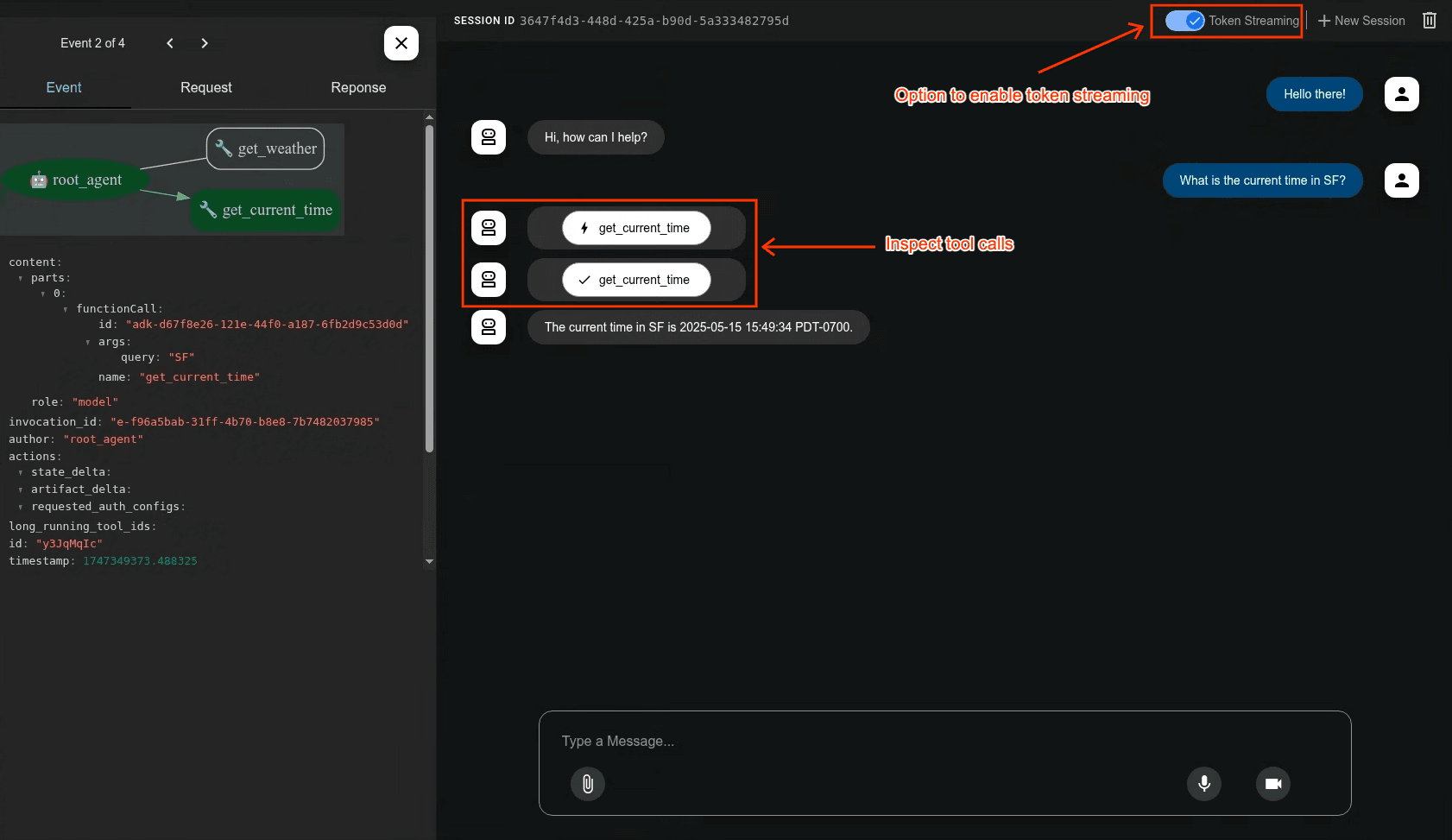
A built-in development UI to help you test, evaluate, debug, and showcase your agent(s).
<img src="https://raw.githubusercontent.com/google/adk-python/main/assets/adk-web-dev-ui-function-call.png"/>